SOP training: how to train employees on procedures and prove it
Read-and-sign is fine for low-risk procedures and not enough for the rest. Here is how to tier SOPs by risk, retrain after a change and keep records that name the version.

SOP training is how employees learn to carry out a standard operating procedure the way it is written, and how the company proves they did. A procedure that sits in a shared folder is a document. It becomes the way work gets done only when the people doing the work have been trained on it, checked and recorded.
Most companies handle this with "read and sign": the employee opens the SOP, scrolls to the end and signs a sheet. That is quick, and it tells you almost nothing about whether the person can follow the procedure. This guide explains when read-and-sign is enough and when it is not, how to match the training method to the risk of the procedure, what to do when an SOP changes, and what a training record should contain. We also cover process training, which is the same job one level up. We build LMS Advisor, a learning management system, and the last section says exactly what it does for SOP training and what it does not.
What is SOP training?
SOP training is instruction on a specific written procedure, given to everyone who performs or supervises that procedure, before they do the work unsupervised.
A complete cycle has four parts:
- Assign. The right people are told which procedures apply to their role.
- Teach. They read, watch or are shown the procedure, with the reasons for the critical steps.
- Verify. A quiz, a demonstration or a supervised run confirms they can follow it.
- Record. The company keeps who was trained, on which version, when, how it was verified and by whom.
Leave out verification and you have distribution, not training.
What is the difference between SOP training and process training?
A process is the whole flow of work from start to finish. An SOP is the detailed instruction for one activity inside it.
| Process training | SOP training | |
|---|---|---|
| Covers | The end-to-end flow, for example order to delivery | One activity, for example "Pack a temperature-controlled shipment" |
| Answers | What happens, in what order, who hands off to whom, and why | Exactly how to do this step, with what tools, to what standard |
| Audience | Everyone who touches the process, including managers | The people who perform or check that activity |
| Typical format | A flow diagram walked through in a short course or a live session | The SOP itself plus a demonstration and a check |
Teach the process first. People follow a procedure more carefully when they can see what their step protects further down the line. Both sit among the 22 types in our internal training guide.
Who requires SOP training?
Any business that depends on consistent work needs it. In regulated industries it is written into the rules.
- Pharmaceutical manufacturing. The US current good manufacturing practice rule, 21 CFR 211.25, requires that personnel have the education, training and experience to perform their assigned functions, and that training covers the particular operations the employee performs, including the written procedures that relate to them.
- Quality management systems. ISO 9001 asks an organization to determine the competence people need, make sure they have it and keep documented information as evidence.
- Food, laboratories, aviation, medical devices and healthcare all have their own versions of the same idea.
We are not lawyers or auditors, and the rules differ by country and sector. Check the requirements that apply to you with your quality or regulatory lead. Outside regulated work the case is practical: fewer errors, faster onboarding, and less dependence on the one person who "knows how it's done."
Is read-and-sign enough?
Read-and-sign is enough for low-risk procedures and minor changes. It is not enough for anything where a mistake hurts someone, ruins product or breaks a rule.
Sort your procedures by risk and set the method for each tier once. Then nobody has to argue about it for every document.
| Risk tier | Example procedures | Training method | Verification |
|---|---|---|---|
| Low | Booking a meeting room, naming files, expense claims | Read the SOP | Acknowledgment |
| Medium | Processing a refund, onboarding a supplier, closing a support ticket | Read the SOP plus a short lesson or video walk-through | Quiz with a pass mark, questions on the steps people get wrong |
| High | Line clearance, equipment cleaning, lockout, handling patient samples | Lesson on the reasons, then demonstration at the workstation | Observed performance signed by a qualified trainer, plus a quiz |
A good quiz question for an SOP is about a decision point: "The seal check fails on the second attempt. What do you do next?" A bad one asks who approved the document.
How do you set up SOP training?
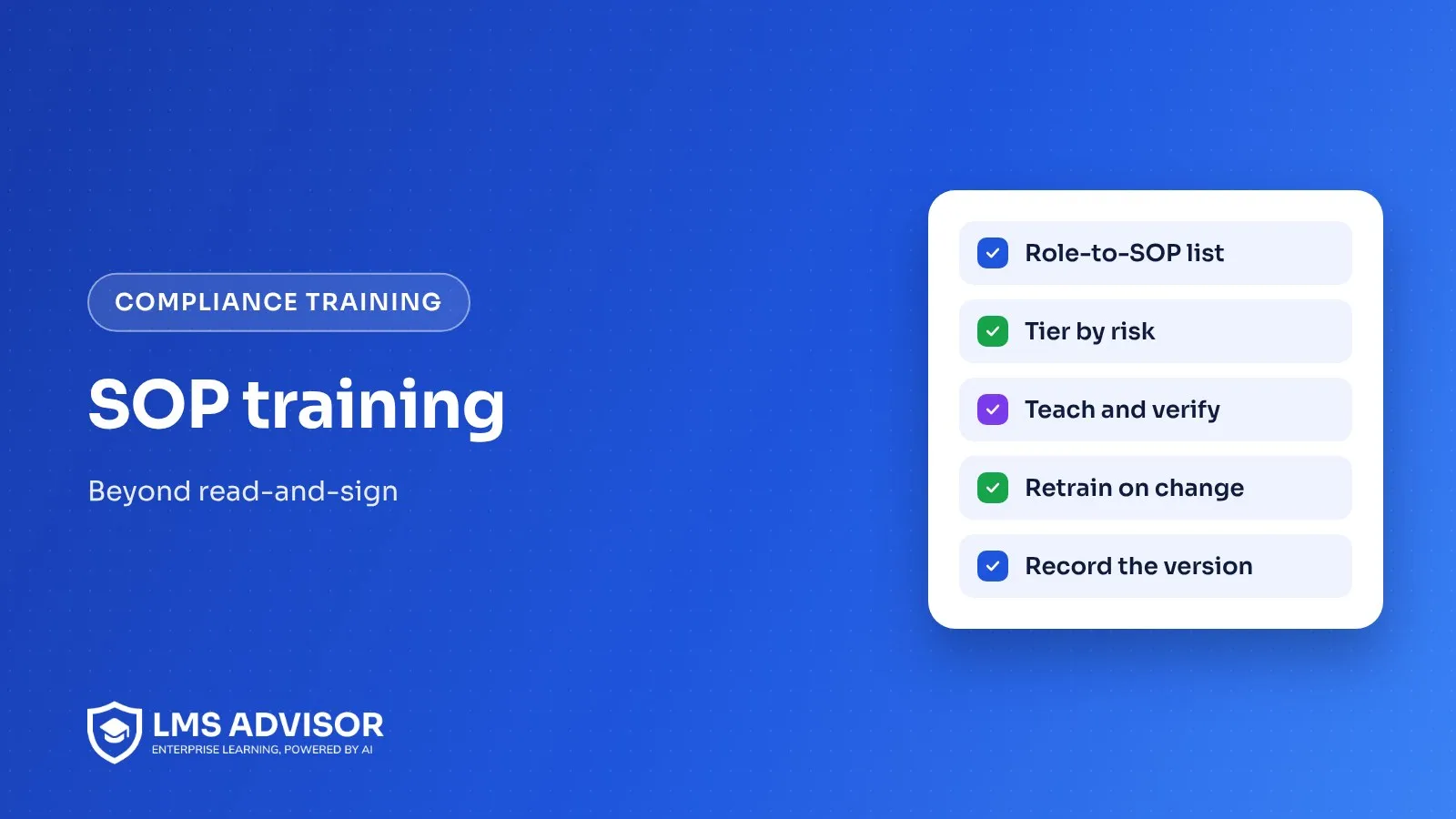
- Build a role-to-SOP list. For each role, list the procedures that apply. This is your training matrix. Keep it short and honest: a role with 140 assigned SOPs has a design problem, because nobody can hold that many in their head.
- Tier each SOP by risk using the table above.
- Write the SOP so it can be taught. Numbered steps, one action per step, photos or screenshots where they help, and the critical steps marked with the reason.
- Prepare the training material. For medium and high tiers, a five to ten minute lesson that shows the procedure being done usually does more than the document alone.
- Assign with a due date before the effective date. People should be trained before a procedure takes effect, not after.
- Verify and record. Quiz, observation or both, according to the tier.
- Set a review period. Many companies retrain on high-risk procedures every one or two years, even with no change. Choose a period and apply it consistently.
What should happen when an SOP changes?
Decide how big the change is, then retrain in proportion.
| Type of change | Example | Retraining |
|---|---|---|
| Editorial | Typo fixed, department renamed | None, or a notice |
| Minor | A form number changes, a step is clarified | Read the summary of changes and acknowledge |
| Major | Steps added, removed or reordered, new equipment, new acceptance limits | Full retraining with verification before the new version takes effect |
Two habits save a lot of trouble. Put a short "what changed and why" note at the top of every revised SOP, so people do not have to compare two versions line by line. And give yourself a gap between approval and the effective date, long enough for every shift to be trained.
What should an SOP training record contain?
- The employee's name and role.
- The SOP title, number and version.
- The date of training.
- The method: read, course, demonstration.
- How it was verified, and the result.
- The trainer or assessor, where there was one.
- The date retraining is due, if you set one.
The version number is the item people forget. A record that says "trained on the cleaning SOP" does not show whether the person was trained on the procedure that is in force today.
What does SOP training look like in practice?
The following three examples are hypothetical. They are here to show the method and do not describe real customers.
Hypothetical example 1: a contract packager
A contract packager has 60 SOPs and an audit finding that operators signed for procedures they could not describe. The quality manager tiers the list: 34 low, 18 medium, 8 high. The eight high-risk procedures each get a short filmed walk-through, a five-question quiz and an observed sign-off by the line trainer. The 34 low-risk ones stay as read-and-acknowledge. Effort goes where the risk is.
Hypothetical example 2: a support team at a software company
A 25-person support team has no regulator, only a refund procedure that half the team gets wrong. The team lead rewrites it as nine numbered steps with screenshots, records a six-minute screen video, and adds four scenario questions. New agents take it in their first week. When the refund limit changes, the lead updates the lesson and assigns it again with a one-week due date.
Hypothetical example 3: a clinical laboratory
A laboratory revises its sample receipt procedure after adding a new analyzer. The change is major. The lab manager sets the effective date three weeks out, runs demonstrations on each shift, has every technician process five samples under observation, and files the signed forms. Until a technician is signed off, they do not receive samples alone.
What goes wrong with SOP training?
- Everything is read-and-sign. High-risk procedures get the same treatment as the expenses policy.
- Too many SOPs per role. People sign 40 documents on their first day and remember none.
- Training after the effective date. For a period, staff are working to a procedure they have not seen.
- Records without versions. Nobody can prove training on the current procedure.
- The SOP does not match the work. If the floor does it differently, find out why before you retrain. Sometimes the procedure is the thing that is wrong.
Where does LMS Advisor fit, and where does it not?
| Part of SOP training | What LMS Advisor does |
|---|---|
| Deliver the procedure | The SOP as a document lesson, with video, images and interactive blocks around it. A minimum time can be set on a lesson, and blocks can be marked as required before the learner moves on. |
| Assign by role | Auto-enrollment rules that match on fields such as department, job title or location, and organization assignments with due dates and a mandatory flag. |
| Verify knowledge | Quizzes that record a pass or a fail, with feedback after each answer or after the learner submits. |
| Evidence of observed practice | An assignment where the signed observation form is handed in as a file or a photo and marked by the trainer. |
| Retraining on a schedule | Course certificates with a validity in months, an expiring-soon status and renewal by retaking the course. |
| Chasing and reporting | Overdue reports, a weekly digest to managers of overdue mandatory training, and exports to CSV, Excel and PDF. |
The limits. LMS Advisor is not a document control system. It does not manage SOP approval, and it does not retrain people automatically when a document changes in another system. When a procedure is revised, someone updates the lesson and assigns the course again, and you record the SOP version in the course title or description. It has no training matrix or skills matrix built in, so the role-to-SOP list lives in a spreadsheet. We hold no certification or attestation for regulated record-keeping, so if you work under rules such as 21 CFR Part 11, review that with your quality team first. For a starting point on the matrix, use our training matrix template. For where SOP training sits in a wider program, read the corporate training guide. To walk through your own procedures, book a demo.
Frequently asked questions
What does SOP training mean?
SOP training means teaching employees to carry out a standard operating procedure as written and confirming they can. It includes assigning the procedure, teaching it, verifying understanding and keeping a record.
Is read-and-sign training acceptable?
It is acceptable for low-risk procedures and minor changes. For procedures where an error affects safety, product quality or compliance, add a quiz or an observed demonstration.
How often should SOP training be repeated?
Repeat it whenever the procedure changes in a major way. Many companies also retrain on high-risk procedures every one or two years, but the period is yours to set unless your regulator gives one.
Who should deliver SOP training?
Someone who performs the procedure well and has been shown how to teach it, usually a line trainer or supervisor. The document owner should be available for questions about why the steps are written as they are.
What is the difference between an SOP and a work instruction?
An SOP describes what must be done and who is responsible for an activity. A work instruction is more detailed and describes exactly how one task is performed at one workstation. Training usually covers both together.
Can LMS Advisor manage SOP training?
It delivers the SOP as a lesson, assigns it by role, checks understanding with a quiz, sets a retraining period and reports who is overdue. It does not control document versions, so a revised SOP is updated and reassigned by an admin.
Add lmsadvisor.com as a preferred source on Google, or open this article in your AI assistant to use it as a source.

The LMS Advisor team builds and supports an AI-powered platform for learning, exams and compliance.