OSHA general industry training requirements: 14 standards in one table
Who must be trained, when, how often and what record each standard names, for fourteen common 29 CFR 1910 standards, with a link to each one.

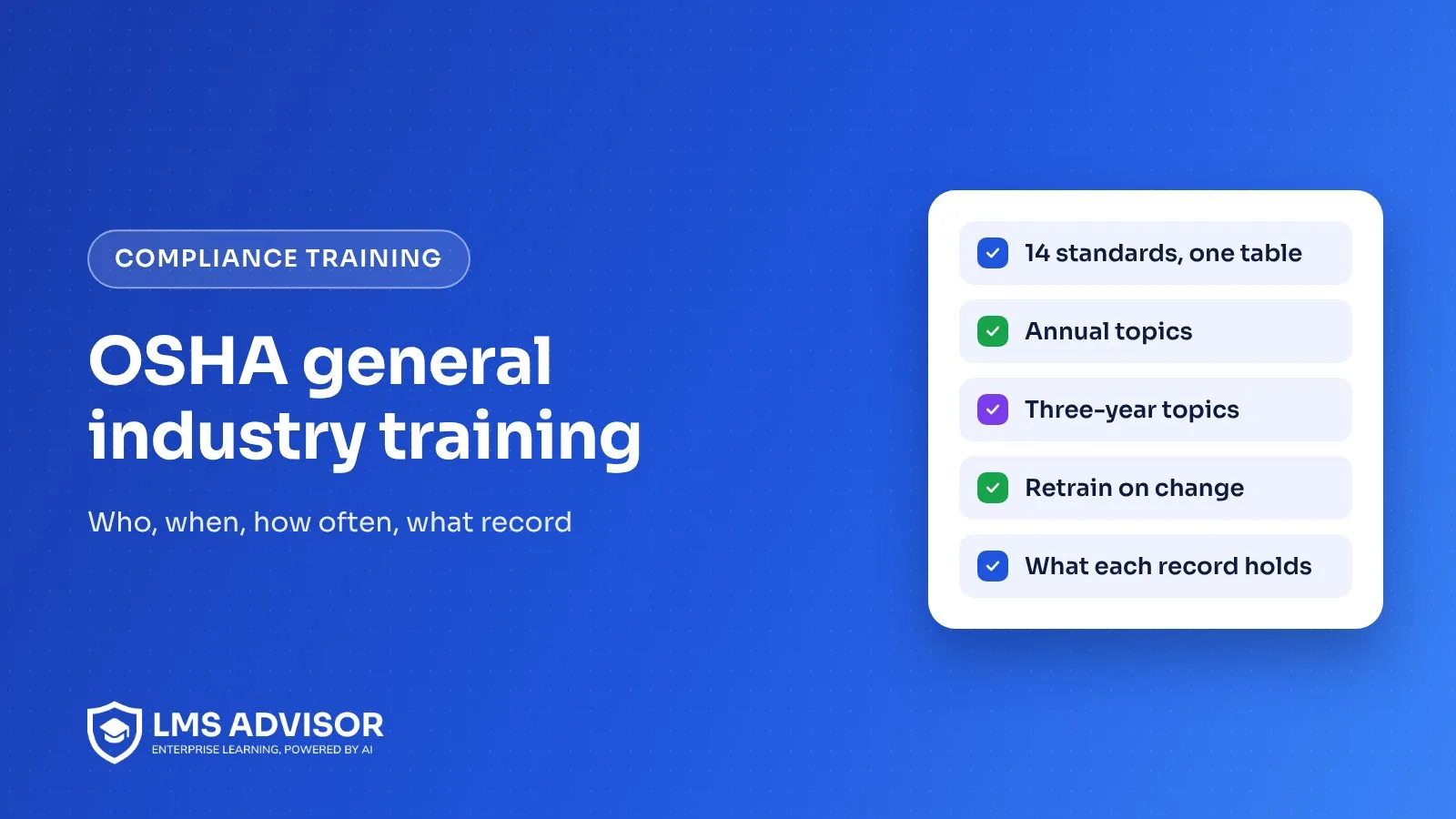
OSHA general industry training requirements are not in one rule. They are spread through the individual standards of 29 CFR part 1910, and each standard sets its own trigger, frequency and record. The table below puts fourteen of the most common ones side by side, with a link to each standard so you can read the wording yourself.
A note on what this is. We build LMS Advisor, a learning management system. We are not lawyers or safety consultants, and this is general information, not legal advice. We read each standard on osha.gov in November 2026 and summarized it in plain words. A summary leaves things out. State plans can add requirements, and construction, maritime and agriculture have their own parts. Confirm what applies to you with a qualified safety professional.
Where are OSHA's training requirements written down?
In each standard, usually in a paragraph headed "Training" or "Information and training". OSHA collects them in one publication, Training Requirements in OSHA Standards (OSHA 2254), which is the best single starting point.
Three things are true across the standards:
- The hazard decides, not the job title. A standard applies because an employee is exposed to the hazard it covers. An office worker who never enters the plant is not in the hearing conservation program.
- Training has to be understood. OSHA's training standards policy statement says required training must be presented in a manner and language employees can understand. Several standards say so in their own text.
- State plans may ask for more. States with their own OSHA-approved programs must be at least as effective as federal OSHA. See OSHA's state plans page.
OSHA general industry training requirements table
| Topic and standard | Who | When | Repeat | Record the standard names |
|---|---|---|---|---|
| Emergency action plans, 1910.38 | Employees designated to help with evacuation, and each employee covered by the plan | When the plan is developed or the employee is first assigned | When responsibilities or the plan change | None named for training |
| Fall protection and equipment, 1910.30 | Each employee who uses personal fall protection systems or equipment covered by the subpart | Before exposure to a fall hazard, and before using the equipment | When the employer has reason to believe understanding or skill is lacking | None named. Training must be understandable |
| Hearing conservation, 1910.95(k) | Each employee exposed at or above an 8-hour average of 85 decibels | No separate start date in paragraph (k). The employer must run a training program for each exposed employee | Annually | None named in paragraph (k) |
| Process safety management, 1910.119(g) | Each employee involved in operating a covered process | Before operating a newly assigned process | At least every three years, and more often if necessary | The employee's identity, the date of training and the means used to verify understanding |
| Hazardous waste operations (HAZWOPER), 1910.120(e) | Workers and supervisors at covered hazardous waste sites | Before work: 40 hours off site plus three days of field experience for general site workers, 24 hours plus one day for occasional and low-exposure workers | Eight hours of refresher training annually | A written certificate from the instructor |
| Personal protective equipment, 1910.132(f) | Each employee required to use PPE | Before doing work that needs the PPE, with the employee showing they understand and can use it | When the workplace or the PPE changes, or understanding is lacking | None named in paragraph (f) |
| Respiratory protection, 1910.134(k) | Employees required to use respirators | Before the employee uses a respirator in the workplace | Annually, and when changes or gaps in knowledge call for it | None named in paragraph (k) |
| Permit-required confined spaces, 1910.146(g) | All employees whose work the section regulates | Before first assigned duties and before a change in duties | When operations change or there are deviations or gaps | A certification with each employee's name, the signatures or initials of the trainers and the dates of training |
| Lockout/tagout, 1910.147(c)(7) | Authorized, affected and other employees, each for their role | As part of the energy control program, so each employee has the knowledge and skills for their role | When job assignments, machines, processes or procedures change | A certification with each employee's name and dates of training |
| Portable fire extinguishers, 1910.157(g) | Employees where the employer provides extinguishers for employee use | Upon initial employment | At least annually | None named in paragraph (g) |
| Powered industrial trucks, 1910.178(l) | Each operator | Before operating a truck: formal instruction, practical training and an evaluation in the workplace | An evaluation of performance at least once every three years, with refresher training when triggered | A certification with the operator's name, the training date, the evaluation date and the identity of the people who trained or evaluated |
| Electrical safety-related work practices, 1910.332 | Employees who face a risk of electric shock not reduced to a safe level by the installation requirements | For their job assignments, by classroom or on-the-job training | No interval stated in this section | None named in this section |
| Bloodborne pathogens, 1910.1030(g)(2) | Employees with occupational exposure | At initial assignment to tasks where exposure may take place | At least annually | Dates, a summary of contents, the trainer's name and qualifications, and the names and job titles of attendees, kept for 3 years |
| Hazard communication, 1910.1200(h) | Employees exposed to hazardous chemicals in their work area | At the time of initial assignment | Whenever a new chemical hazard is introduced | None named in paragraph (h) |
"None named" means that paragraph does not spell out a training record. It does not mean you can do without one. If an inspector asks whether a worker was trained, you still have to show it. Keep a record for every row.
What patterns matter when you plan the training?
Read down the columns and four patterns appear. They decide how you set up a calendar, a spreadsheet or an LMS.
Three kinds of clock
- Annual. Hearing conservation, respirators, fire extinguishers, bloodborne pathogens and the HAZWOPER refresher repeat every year.
- Three-year. Forklift operators are evaluated at least once every three years, and process safety refresher training is due at least every three years.
- Event-driven. Lockout/tagout, hazard communication, PPE, confined spaces and fall protection have no fixed interval in the paragraphs above. Retraining follows a change in the job, the equipment, the chemicals or the procedure, or a sign that someone has not understood.
The third group is the one that gets missed, because nothing on a calendar reminds you. Tie the retraining to the change itself: when engineering signs off a new machine or purchasing approves a new chemical, training is a step in that process.
Before, not after
Most rows say "before". Before using a respirator, before exposure to a fall hazard, before operating the truck. Training scheduled for the end of a new starter's first month is late for these.
Knowledge and hands-on are separate
The forklift standard asks for formal instruction, practical training and an evaluation in the workplace. The PPE standard asks the employee to show they can use the equipment. The electrical section calls for classroom or on-the-job training. An online course can carry the knowledge. Someone qualified still has to watch the person do it. Our article on whether online OSHA training is acceptable goes through OSHA's own letters on this.
Some records are specified, most are not
Five rows name what the record must hold. Notice how they differ: confined spaces asks for trainer signatures or initials, forklifts ask for two dates and the evaluator's identity, bloodborne pathogens asks for the trainer's qualifications and a three-year retention. One generic "completed" tick does not satisfy all of them. For retention periods across rules, see our training records retention table.
What should a training record hold to cover every row?
If you record these nine fields for every session, you cover what the five record-naming rows ask for and have a sound answer for the rest.
- Employee name and job title.
- Topic, and the standard it relates to.
- Date of training.
- Date of any practical evaluation, if separate.
- Trainer or evaluator name.
- Trainer qualifications, where the rule asks.
- Trainer signature or initials, where the rule asks.
- A summary of the content, or the version of the course.
- How understanding was checked: quiz score, demonstration, observation.
Then add a next-due date for the annual and three-year rows, and a note of what change would trigger retraining for the rest.
How do you turn the table into a training matrix?
- List your hazards, not your departments. Walk the site with the table. Which rows apply anywhere on site? Strike the ones that do not.
- List who is exposed to each. By role and location. "Maintenance technicians, both shifts" and "anyone issued a respirator".
- Set the clock for each row. Annual, three-year or event-driven, using the standard and any stricter state rule.
- Split each row into parts. Knowledge, hands-on practice, evaluation. Decide who delivers each.
- Decide the record. Use the nine fields above, plus whatever the standard names.
- Add what the table leaves out. Your own procedures, equipment the manufacturer wants trained, insurer and customer requirements.
The training matrix template gives you a layout to fill in. If you work in construction, the equivalent table for part 1926 is in our OSHA construction training requirements article.
What does this look like in practice?
The two examples below are hypothetical. They illustrate the method and are not real customers or a compliance template.
Hypothetical example 1: a 120-person metal fabrication plant
The safety coordinator walks the plant with the table and keeps nine rows. She finds the annual topics are tracked on a wall calendar, and lockout/tagout was last trained four years ago even though two presses were replaced in that time. She adds "training reviewed" as a line on the equipment change form, sets the annual topics to renew by each person's own date, and has the forklift evaluator sign a short form for each operator that is filed against that operator.
Hypothetical example 2: a multi-site dental group
Most of the table does not apply to a dental practice. The compliance lead keeps four rows: bloodborne pathogens, hazard communication, PPE and emergency action plans. Bloodborne pathogens training is an online module followed by a live question session with a qualified trainer, and the record holds the trainer's name and qualifications. Our dental OSHA training requirements article covers that setting in more detail.
Where does LMS Advisor fit, and where does it not?
| Need from the table | What LMS Advisor does |
|---|---|
| Assign by exposure | Auto-enrollment rules by department, job title or location, and assignments with due dates and a mandatory flag. |
| Annual and three-year clocks | Course certificates with a validity in months, an expiring-soon status 30 days ahead and renewal by retaking the course. |
| Event-driven retraining | An admin reassigns the course to the affected group when the change happens. The system does not detect the change for you. |
| Hands-on sessions | Classroom sessions with a trainer, location and date, attendance by QR check-in or a printable sign-in sheet. |
| Signed evaluation forms | An assignment where the signed form or a photo of it is handed in and kept on the worker's record. |
| Understandable training | Lesson versions in different languages, with AI translation as a draft for a person to check. |
| The export | Completion, attendance and certificate reports to CSV, Excel and PDF, with audit logs. |
The limits. LMS Advisor supplies no safety courses and is not an OSHA-authorized Outreach provider. It has no training matrix that maps roles to standards, no electronic signature and no supervisor observation checklist, so trainer initials and evaluation forms are captured as uploaded documents. It does not know which standards apply to you. It is not an EHS system and holds no compliance certification. To see how these records look, visit the safety training LMS page or book a demo. If you are choosing software, our comparison of the best LMS for safety training covers ten options.
Frequently asked questions
What are the OSHA general industry training requirements?
They are the training duties in individual standards of 29 CFR part 1910, such as hazard communication, lockout/tagout, forklifts, respirators and bloodborne pathogens. Each sets its own audience, timing and record. OSHA publication 2254 lists them.
Which OSHA training is required annually?
Among common general industry standards, hearing conservation, respiratory protection, portable fire extinguishers, bloodborne pathogens and the HAZWOPER refresher repeat at least annually. Others repeat every three years or when something changes.
How often is forklift training required?
Each operator's performance must be evaluated at least once every three years under 29 CFR 1910.178(l). Refresher training is also required after events such as unsafe operation, an accident or a change in truck or workplace.
Does OSHA require written training records?
Some standards do. Forklifts, lockout/tagout, confined spaces, process safety and bloodborne pathogens each name what the record must contain. Others are silent, but you still need to show the training happened.
Does an OSHA 10-hour card cover these requirements?
No. OSHA says Outreach training is voluntary and does not fulfill the training requirements found in OSHA standards. The card is an orientation. The standards still need their own training.
Can OSHA general industry training be done online?
The knowledge part often can. Standards that ask for practical training, a demonstration or a workplace evaluation also need an in-person element, and some require a chance to ask the trainer questions.
Add lmsadvisor.com as a preferred source on Google, or open this article in your AI assistant to use it as a source.

The LMS Advisor team builds and supports an AI-powered platform for learning, exams and compliance.