On-the-job training (OJT): how to structure it and prove it happened
On-the-job training works when it has a task list, a prepared trainer, a four-step method and a sign-off. Here is how to build it, with a sample checklist.

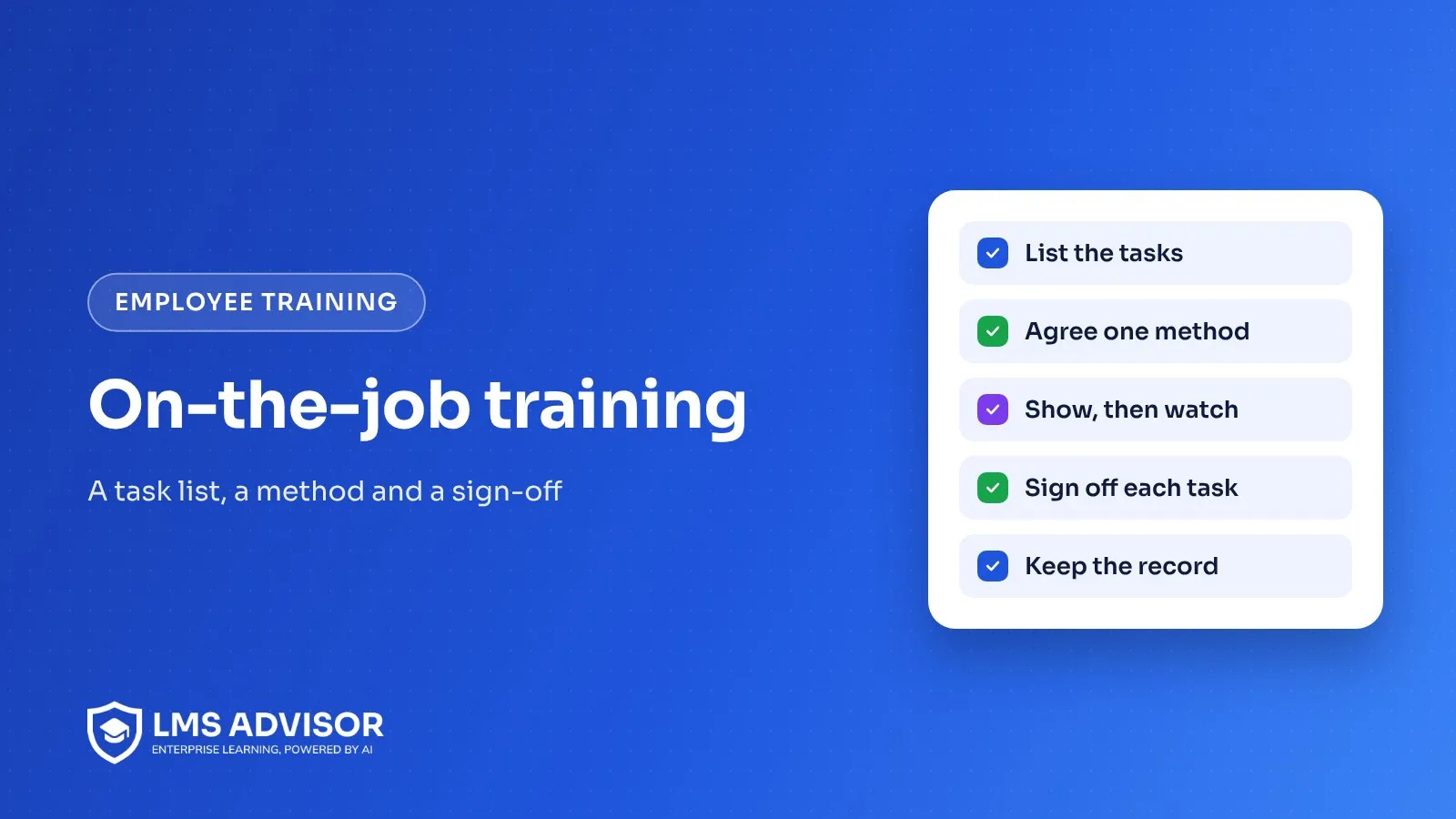
On-the-job training (OJT) is training that happens at the workplace, on the real task, with an experienced colleague or supervisor showing the new person how to do it and then watching them do it. It is the oldest training method there is, and for most practical jobs it is still where the real learning happens.
It is also the method most often left to chance. "Follow Dave around for a week" is on-the-job training in name only. Whether the new hire ends up competent depends on which Dave they got. This guide shows how to give OJT a structure: a task list, a trained trainer, a four-step teaching method, a sign-off and a record. We make LMS Advisor, a learning management system, and near the end we explain honestly which parts of OJT software can help with and which parts stay on the shop floor.
What is on-the-job training?
On-the-job training is one-to-one or small-group instruction given in the normal work setting, using the actual tools, equipment, documents and systems of the job.
It comes in two forms:
- Unstructured OJT. The new person shadows someone and picks things up. There is no list of what to cover, no standard method and no check at the end. It is cheap to start and expensive later, because every trainer passes on their own shortcuts.
- Structured OJT. There is a written list of tasks for the role, a standard way to perform each one, a named trainer who has been shown how to teach, a planned sequence and a sign-off against a clear standard. This is the form worth building.
OJT is one of the 15 face-to-face methods in our classroom training guide, next to apprenticeships, job shadowing and hands-on workshops.
How is OJT different from job shadowing, coaching and apprenticeship?
| Method | What the learner does | Typical length | Ends with |
|---|---|---|---|
| Job shadowing | Watches. Does little or none of the work. | Hours to a few days | Usually nothing formal |
| On-the-job training | Watches, then performs the task under supervision until they meet the standard. | Days to a few months | A sign-off per task |
| Coaching | Already does the job and works with a coach to improve. | Ongoing | Agreed goals reviewed over time |
| Apprenticeship | Combines long-term paid OJT with related classroom instruction toward a recognized trade. | One to several years | A recognized credential |
Apprenticeship is OJT at its most formal. In the United States, the standards for registered programs in 29 CFR 29.5 describe time-based programs with at least 2,000 hours of on-the-job learning, and recommend a minimum of 144 hours of related instruction for each year.
When does on-the-job training work best?
OJT works best when the skill is physical or procedural, the conditions of the real job matter, and the standard can be observed.
- Operating a machine, a vehicle, a till or a production line.
- Following a procedure in the company's own software, with real records.
- Tasks where local detail matters: this site's layout, this customer's paperwork, this kitchen's stations.
- Skills a regulator expects to be practiced and evaluated in the workplace. OSHA's forklift rule, 29 CFR 1910.178(l), is a clear example: operator training must combine formal instruction, practical training and an evaluation of the operator's performance in the workplace.
It works poorly on its own when there is a lot of background knowledge to absorb first, when a mistake by a beginner is dangerous or costly, or when the only available trainer is too busy to stop and explain. In those cases put the theory into a short course first and use a practice area or a simulator before the live job.
How do you build a structured OJT program?
Seven steps take you from "follow Dave" to a program you can repeat and prove.
- List the tasks for the role. Sit with two or three good performers and write down what a competent person does in a normal week. Aim for 15 to 40 tasks. "Change the label roll on line 3" is a task. "Understand the labeling process" is not.
- Agree on the one right way. For each task, write the key steps and the points that affect safety or quality. If your experienced people disagree on the method, settle that before you train anyone.
- Choose and prepare the trainers. Your best operator is not always your best trainer. Pick people who are patient and consistent, show them the teaching method below, and give them time in the schedule. Training someone while still hitting a full output target does not work.
- Sequence the tasks. Start with what is safe, frequent and simple. Leave rare and risky tasks until the basics are solid.
- Put the theory first. Safety rules, product knowledge and the reasons behind the steps fit well in short self-paced lessons the new hire completes before each block of practice.
- Train and sign off, task by task. The trainer teaches, the learner practices, and a supervisor or the trainer confirms the standard was met. Date and sign each task.
- Keep the record and review the program. Store the completed checklist with the person's training record. Every few months, look at where new hires struggled and fix the task list or the method.
How should a trainer teach a task?
Use the four-step job instruction method. It came out of the Training Within Industry program that the United States ran during the Second World War to get new factory workers productive quickly, and it has barely needed changing since.
- Prepare the learner. Put them at ease, say what the task is, find out what they already know and place them where they can see.
- Show the task. Do it once at normal pace. Do it again slowly, naming each key step. Do it a third time explaining why each key point matters, especially the ones that prevent injury or scrap.
- Let them try. The learner does the task while the trainer watches and corrects. Then the learner does it again while explaining the steps and the reasons back. Repeat until the trainer is confident.
- Follow up. Leave them to work, say who to ask for help, check back often at first and then less.
The step people skip is having the learner explain the reasons back. It feels slow. It is also the only way to find out whether they understood or simply copied the movements.
What does an OJT checklist look like?
An OJT checklist is one row per task, with space for who trained it, who signed it off and when. Here is a short extract for a hypothetical warehouse picker role.
| Task | Standard | Theory done | Shown by | Practiced (times) | Signed off by | Date |
|---|---|---|---|---|---|---|
| Scan and pick a single-line order | Correct item and quantity, scanned at the shelf, 10 orders with no errors | Yes | R. Okafor | 12 | Shift lead | Day 2 |
| Handle a short pick | Follows the short-pick screen, labels the tote, tells the lead | Yes | R. Okafor | 4 | Shift lead | Day 4 |
| Use the pallet jack in aisles | Pre-use check done, speed and horn rules followed, load stable | Yes | Site trainer | 6 | Site trainer | Day 5 |
| Report a damaged item | Photo taken, damage code entered, item moved to the quarantine bay | Yes | R. Okafor | 2 | Shift lead | Day 6 |
Write the standard so two different supervisors would reach the same verdict. "Competent" is an opinion. "Ten orders with no errors" is something you can count.
What does OJT look like in practice?
These three examples are hypothetical. They illustrate the approach and are not accounts of real customers.
Hypothetical example 1: a machine shop with one expert
A 40-person machine shop has one setter who knows the older lathes. He retires in 18 months. The owner has him list the 22 setup tasks, films him doing each one on a phone, and pairs him with two younger machinists for two hours a week. Each task gets signed off only after the learner has done it three times unaided. The short videos stay as reference after he leaves.
Hypothetical example 2: a restaurant group opening a new site
A restaurant group opens its sixth location with 35 new staff. Food safety and allergen rules are assigned as phone-sized lessons before the first shift. In the kitchen, each station has a one-page checklist, and a trainer from an existing site runs the four-step method for a week. Nobody works a station alone until the head chef has signed that station off.
Hypothetical example 3: a claims team in an insurance office
OJT is not only for manual work. A claims team writes down 18 claim types. New adjusters complete a short course on policy wording, then handle each type alongside a senior adjuster who reviews every decision until five in a row are correct. The sign-off sheet shows the team leader who can be given which work.
What goes wrong with on-the-job training?
- Bad habits get copied. Without an agreed method, each trainer teaches their own version, including the shortcut that skips the guard.
- The trainer has no time. Training is added on top of a full workload, so it gets rushed.
- Sign-off means "they were there." A signature should mean the person met a stated standard while being watched.
- Nothing is written down. When an incident or an audit comes, nobody can show who trained whom on what.
- It never ends. Without a task list, nobody knows when the new hire is finished training.
Where does LMS Advisor fit, and where does it not?
The teaching in OJT happens between two people at a workstation. No software does that part. What an LMS can do is deliver the theory beforehand and hold the evidence afterward.
| Part of OJT | What LMS Advisor does |
|---|---|
| Theory before practice | Short lessons, video and quizzes on the web and in the iOS and Android apps. Downloaded video, audio and document lessons work offline in the apps. |
| Order of training | Learning paths put courses in a set sequence with a due date, and can be assigned by organization so new hires are enrolled automatically. |
| Evidence of a practical task | An assignment the learner hands in as a file, a photo or a camera shot from the app, such as the signed checklist page. The trainer or supervisor marks it against a rubric. |
| Group practical sessions | Classroom sessions with a location, a trainer, a printable sign-in sheet and QR check-in. |
| The record | Certificates with a validity period for tasks that need renewal, a transcript per person and reports that export to CSV, Excel and PDF. |
The limits, plainly. LMS Advisor has no dedicated on-the-job observation checklist that a supervisor ticks off on the floor, and no skills matrix or competency framework. The task checklist itself lives on paper or in a spreadsheet, and the signed copy is uploaded as evidence. We also do not supply ready-made courses, so the theory lessons are yours to write or buy. If that split suits you, the employee training page shows the setup, and you can book a demo with one of your own roles as the example. For how OJT fits into a wider program, see the corporate training guide.
Frequently asked questions
What is on-the-job training?
On-the-job training is instruction given at the workplace on real tasks, by an experienced colleague or supervisor. The learner watches, practices under supervision and is signed off when they meet the standard.
What is an example of on-the-job training?
A new warehouse picker learning to scan and pick orders beside a trained colleague is a typical example. The colleague shows the task, watches the new hire do it and a shift lead signs off once ten orders are picked without error.
What are the four steps of on-the-job training?
The four steps are prepare the learner, show the task, let the learner try while explaining it back, and follow up. This is the job instruction method from the Training Within Industry program.
What is the difference between structured and unstructured OJT?
Structured OJT follows a written task list, a standard method and a sign-off for each task. Unstructured OJT is informal shadowing with no plan, so the result depends on who the trainer happens to be.
How long should on-the-job training last?
It lasts as long as it takes to sign off every task on the list for the role. For simple roles that can be a week or two, and for skilled trades it runs to months or years as part of an apprenticeship.
Can an LMS track on-the-job training?
Yes, for the theory and the evidence. In LMS Advisor the theory runs as courses, and the signed checklist or a photo of the finished task is handed in as an assignment and marked by the supervisor. The observation itself still happens in person.
Add lmsadvisor.com as a preferred source on Google, or open this article in your AI assistant to use it as a source.

The LMS Advisor team builds and supports an AI-powered platform for learning, exams and compliance.